
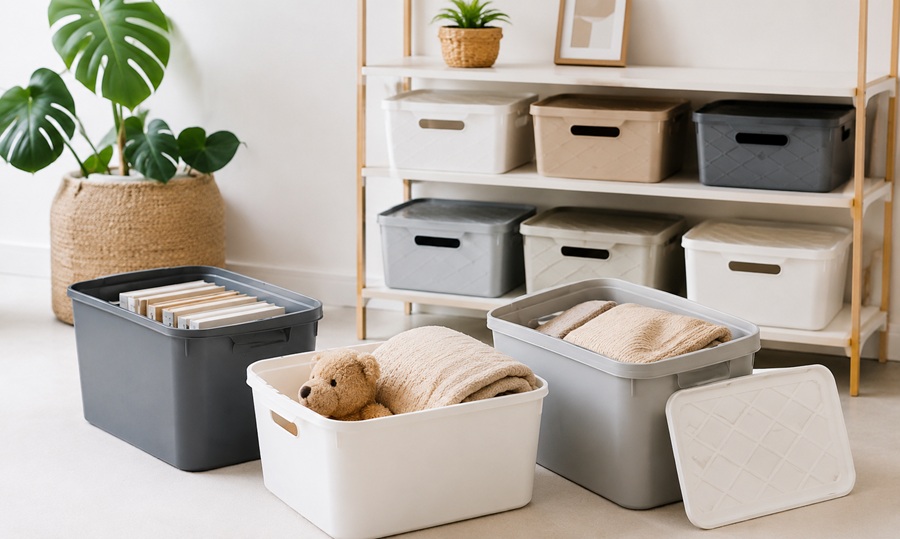
The right storage bin depends more on the room than the brand. Kitchens need bins that fit inside cabinets and pull out easily; closets need stackable bins that hide contents; garages need bins tough enough to sit on concrete and survive temperature swings. Material and size matter far more than price tier once you’ve matched the bin to its room, and most households end up needing at least three different bin types rather than one universal size.
Before buying anything, it helps to run through what actually separates a bin that lasts from one you’ll replace in a year.
Quick Answer: What to Look For in Storage Bins
- Material thickness — press on the side wall; if it flexes easily, it will crack under stacked weight
- Lid type — locking latches outperform snap-on lids for anything stored long-term
- Base strength — reinforced corners prevent the bottom from sagging when stacked
- Transparency — clear or semi-clear bins save time finding contents later
- Size consistency — matching dimensions across a set stack more securely than mixed sizes
Detailed Guide by Room
Kitchen storage bins should be shallow and open-top or have easy-lift lids, since you’ll be reaching into them frequently for pantry items or under-sink supplies. Clear bins are almost mandatory here — opaque bins in a pantry just relocate the “what’s in here” problem rather than solving it.
Closet storage bins work best as a stackable, uniform set. Fabric bins with rigid frames look more finished on open shelving, while solid plastic bins with lids are better for top-shelf or under-bed storage where you’re not opening them daily. Under-bed bins specifically should be low-profile — measure the clearance under your bed frame before buying, since standard bins often don’t fit.
Garage storage bins need to handle concrete floors, temperature swings, and occasional moisture. Heavy-duty plastic with a locking lid is the standard here, and it’s worth spending more per bin than you would in a closet, since garage bins see rougher conditions and are harder to replace mid-project.
Kids’ room storage bins benefit from softer materials (fabric or rounded plastic) since they’ll be handled roughly and sometimes used as step stools despite instructions otherwise. Bright colors or clear fronts also help younger kids sort toys back into the correct bin without adult supervision.
How Should You Organize a Storage Bin System?
Group bins by category first, then by frequency of use. Items you need weekly should be at eye level or in the most accessible bins; seasonal or rarely used items belong on top shelves or in the back of a closet. Labeling every bin — even clear ones — saves time, since contents shift and become harder to identify at a glance once a bin is more than half full.
What’s the Difference Between Storage Bins and Storage Totes?
The terms are used almost interchangeably in most retail listings, but “tote” more often implies a bin built specifically for moving or hauling, sometimes with reinforced handles or a more rectangular shape for truck-bed stacking. “Bin” is the broader term and covers everything from small desk organizers to large garage containers.
Clear vs. Opaque vs. Fabric Bins: Which Should You Choose?
Clear bins win on convenience for anything you’ll open regularly — pantries, craft supplies, and closets where you’re identifying contents at a glance. The tradeoff is aesthetics; a shelf of clear bins showing miscellaneous contents doesn’t always look as finished as a matching set of opaque or fabric bins.
Opaque bins hide contents and often look more polished on open shelving, but they require consistent labeling to stay functional — skip the labels and you’ll end up opening multiple bins just to find one item, which defeats much of the organizational benefit.
Fabric bins with rigid internal frames strike a middle ground for closets and nurseries, offering a softer, more decorative look while still holding shape well enough to stack or slide onto a shelf. They’re a poor choice for garages or basements, though, since fabric absorbs moisture and doesn’t protect contents from dust or pests the way sealed plastic does.
Do You Need Different Bins for Different Seasons?
Not necessarily different bins, but different bin placement. Off-season items — holiday decorations, winter coats in summer, summer sporting gear in winter — belong on higher or harder-to-reach shelves, freeing up the most accessible storage for whatever’s currently in seasonal rotation. Rotating bin placement twice a year takes very little time and meaningfully improves how usable a storage system feels day to day, compared to a static layout that ignores seasonal access patterns.
Tips for Long-Term Storage Bin Organization
- Buy bins in one consistent brand or line so lids are interchangeable across sizes
- Leave 10 to 15 percent of shelf space empty rather than filling every inch, so bins can be pulled without shifting the whole stack
- Re-label bins any time contents change significantly, rather than crossing out old labels
- Store the bins you access most often on middle shelves — not the floor, not the top — to avoid unnecessary bending or reaching
A mismatched collection of bins is one of the most common reasons home organization projects stall out. Standardizing size and brand within each room, even if it means a slightly higher upfront cost, tends to be the difference between a system that stays organized and one that slowly falls apart.
How Much Should You Budget for a Full-Home Bin System?
For a household tackling closets, a garage, and general overflow storage all at once, a reasonable budget lands between $250 and $600 total, spread across 20 to 35 bins of varying sizes. Spreading the purchase across a few months — starting with the room causing the most daily frustration — tends to produce better results than buying everything at once, since it gives you a chance to see what’s actually working before committing to bins for every remaining space.
It’s also worth setting aside a small portion of that budget, roughly 10 percent, for replacement bins. Even durable bins occasionally crack a lid or lose a latch, and having a couple of spares on hand from the same product line prevents a mismatched bin from creeping into an otherwise uniform set.
Common Storage Bin Mistakes to Avoid
Buying every bin for a project in one trip before sorting belongings is one of the most frequent missteps, since it’s nearly impossible to accurately estimate how many bins of each size you’ll need until you can see everything laid out. A related mistake is choosing bin size based on what fits a specific shelf rather than what suits the contents — a bin that fits a shelf perfectly but is too small for the items meant to go in it just creates a second sorting problem later. Finally, skipping labels on the assumption you’ll remember what’s inside is a mistake nearly everyone makes once and corrects after the fact; even a system of just three or four broad category labels per room saves meaningful time within the first few months of use.
Frequently Asked Questions
What size storage bin is best for a closet shelf?
Most closet shelving fits bins in the 12 to 20 gallon range best, since deeper bins often don’t clear standard shelf depth. Measure your shelf depth before buying to avoid bins that hang over the edge.
Are stackable bins better than bins on individual shelves?
Stackable bins save space when floor or shelf area is limited, but individual shelving makes each bin easier to access without unstacking others. The right choice depends on how often you need each bin.
How do you stop bins from smelling musty in storage?
Make sure bins are fully dry before sealing the lid, and avoid storing bins directly on concrete floors, which hold moisture. A thin pallet or shelf riser underneath helps keep bins dry in damp basements or garages.
Can storage bins be used for long-term document storage?
Yes, with a sealed, latching lid bin kept in a stable, dry location. For important paper documents, adding a moisture-absorbing packet inside the bin offers extra protection against humidity damage.
