
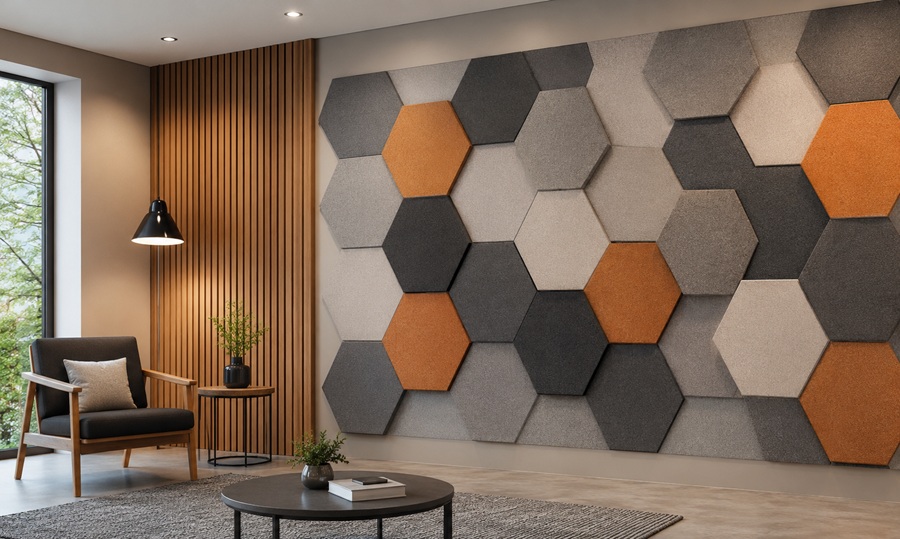
Wall acoustic panels absorb sound energy within a room, reducing echo and reverberation so speech, music, and calls sound clearer. They do not block sound from passing through walls to other rooms — that’s a separate problem requiring mass and sealed construction, not surface absorption. Panels are rated using an NRC (Noise Reduction Coefficient) score from 0 to 1, and anything above 0.7 is considered strong performance for a household or office panel.
Most people shopping for acoustic panels have a specific problem in mind — an echoey home office, a media room that sounds harsh, or a home studio that needs cleaner recordings — and the right panel choice depends heavily on which of those you’re solving for.
What Is an NRC Rating and Why Does It Matter?
NRC measures how much sound a material absorbs versus reflects, expressed as a decimal between 0 (fully reflective) and 1 (fully absorptive). A panel rated 0.75 absorbs roughly 75 percent of the sound energy that hits it. Decorative panels sold primarily for their look sometimes skip this rating entirely, which is a reasonable signal that acoustic performance was a secondary design goal.
How Many Panels Do You Need for a Room?
A common starting formula is covering 15 to 25 percent of total wall surface area with acoustic panels for noticeable improvement in an average room. For a 12-by-12-foot room with 8-foot ceilings, that works out to roughly 60 to 100 square feet of panel coverage across all walls combined. Rooms used for recording or serious video conferencing often need coverage closer to 25 to 30 percent, concentrated at reflection points rather than spread evenly.
Where Should You Place Acoustic Panels?
Reflection points matter more than total coverage. In a home office or media room, the wall directly behind your speakers or monitor, and the wall you’re facing, are the two highest-priority spots. For a home studio, first-reflection points — found by having someone slide a mirror along the side walls while you sit in your normal listening position and marking where you can see the speaker in the mirror — are the most efficient placement.
Fabric vs. Foam vs. Wood-Backed Panels
Fabric-wrapped panels offer the widest color and pattern range and typically post strong NRC ratings (0.7–0.9) at moderate thickness, making them a common choice for offices and living spaces.
Foam panels (the wedge or pyramid style) are the least expensive and easiest to install, often used in home studios where appearance matters less than raw absorption. They tend to underperform fabric panels of the same thickness for lower-frequency sound.
Wood-backed or wood-slat panels trade some acoustic efficiency for a more finished, decorative look, and work well in living rooms or offices where the panel needs to double as decor rather than disappear into the wall.
Do Thicker Panels Perform Better?
Generally yes, especially for low-frequency sound. A 1-inch panel absorbs high frequencies effectively but does little for bass-heavy reverberation; a 2-inch or thicker panel extends absorption further down the frequency range. Home theaters and music rooms benefit more from thicker panels than a standard home office would.
What’s the Difference Between Sound Absorption and Soundproofing?
This distinction causes more buyer disappointment than any other misunderstanding around acoustic panels. Sound absorption, which is what wall acoustic panels do, improves how a room sounds internally by reducing echo and reverberation. Soundproofing prevents sound from traveling between rooms or to the outside, which requires mass-loaded materials, sealed gaps, and often structural changes like double drywall or decoupled framing. Acoustic panels marketed for “soundproofing” are almost always describing absorption, not blocking, and buyers hoping to stop noise from a neighboring apartment or a home gym below should look into dedicated soundproofing materials instead, since panels alone won’t solve that problem.
How Much Do Wall Acoustic Panels Typically Cost?
Fabric-wrapped panels in standard sizes (24×24 inches, 1-inch thick) typically run $25 to $60 each, meaning a room needing 10 to 15 panels lands in the $300 to $700 range for materials. Foam panels are considerably cheaper, often $10 to $25 for similar coverage, making them a common choice for budget-conscious home studios. Wood-backed decorative panels command a premium, frequently $50 to $120 per panel, reflecting both the acoustic core and the finished wood surface.
Should You Buy Pre-Made Panels or Build Your Own?
DIY acoustic panels — typically a wood frame stretched with fabric over rigid mineral wool or fiberglass insulation — can cost 30 to 50 percent less than comparable pre-made panels, and the core materials often achieve NRC ratings equal to or better than commercial options. The tradeoff is time and a slightly less polished finished look unless you’re comfortable with basic woodworking and fabric work. For a single accent wall or a home studio where budget matters more than aesthetics, DIY panels are a reasonable option. For a living room or office where appearance is a bigger priority, pre-made panels with consistent factory finishing are usually worth the added cost.
How Long Do Acoustic Panels Last?
Quality fabric-wrapped and foam panels typically maintain their acoustic performance for ten to fifteen years with normal indoor use, though foam panels can become slightly more brittle and prone to crumbling at the edges after a decade or more, especially in rooms with significant sunlight exposure. Fabric can fade or collect dust over time, which is worth factoring into color choice — lighter fabrics show dust and discoloration more visibly than mid-tone or darker options. Wood-backed panels tend to outlast fabric or foam panels simply due to the durability of the wood surface, though the acoustic core beneath still ages on a similar timeline to standalone fabric panels.
Real Examples by Room Type
Home office: Two to four fabric panels (24×24 inches, roughly 1 inch thick) placed behind the monitor and on the wall behind the desk chair typically resolve most video-call echo complaints.
Media room: Panels behind the screen wall and on the side walls nearest the main seating area, using thicker 2-inch panels for better bass control during movie playback.
Home studio: A denser cluster of foam or fabric panels at first-reflection points plus corner bass traps, since small rooms build up low-frequency buildup that flat wall panels alone won’t fully resolve.
Can You Install Acoustic Panels Without Damaging Walls?
Yes — most lightweight panels under 2 pounds per square foot mount securely with heavy-duty adhesive strips or Command-style hooks rated for the panel’s weight. Heavier panels, particularly wood-backed styles, are safer on French cleats or wall anchors, since adhesive can weaken over time in rooms with temperature or humidity swings.
Renters and Temporary Installations
For renters or anyone who doesn’t want to commit to permanent wall mounting, freestanding acoustic panels on weighted bases or portable acoustic screens offer a reasonable middle ground. They perform slightly worse than wall-mounted panels at the same reflection points, since positioning is less precise, but they avoid wall damage entirely and can be repositioned as needed, which matters for anyone testing whether acoustic treatment actually solves their specific echo or call-quality problem before investing in a permanent installation.
Frequently Asked Questions
Do acoustic panels work on a brick or concrete wall?
Yes, though mounting requires masonry anchors or adhesive rated for those surfaces rather than standard drywall hardware. The acoustic performance itself isn’t affected by the wall material underneath.
Can acoustic panels be moved once installed?
Adhesive-mounted panels can usually be removed and remounted, though the adhesive strips typically need replacing. French cleat or anchor-mounted panels are easier to reposition without damaging the panel itself.
Do ceiling acoustic panels work as well as wall panels?
Ceiling panels, sometimes called acoustic clouds, are especially effective in rooms with hard flooring, since they address a reflection point that wall panels alone can miss. They’re a useful addition in open-plan rooms with limited wall space.
Will acoustic panels stop noise from a home gym below?
No — that requires soundproofing, not acoustic panels. Panels absorb sound within a room but don’t block sound from transferring through floors or ceilings to adjacent spaces.
